
Format Profiles — CSV Column Mapping
Overview
Section titled “Overview”Format profiles tell Acclo IQ how to read your bank’s CSV exports — which columns are the date, amount, description, and so on. Acclo IQ ships with built-in profiles for major banks, and you can create custom profiles for any bank.
Built-in Profiles
Section titled “Built-in Profiles”Acclo IQ currently ships 18 built-in CSV format profiles:
| Institution | Profile | Format |
|---|---|---|
| Chase | Chase Credit Card | Header CSV |
| Wells Fargo | Wells Fargo | Header CSV |
| Synchrony | Lowe's Credit (Synchrony) | Header CSV |
| Fidelity | Fidelity Cash Management | Header CSV; handles bank preamble rows |
| Bank of America | Bank of America Checking | Header CSV; handles bank preamble rows |
| Bank of America | Bank of America Credit Card | Header CSV |
| Citibank | Citibank Checking | Header CSV; separate debit/credit columns |
| Citibank | Citibank Credit Card | Header CSV; separate debit/credit columns |
| Capital One | Capital One 360 Checking | Header CSV |
| Capital One | Capital One Credit Card | Header CSV; separate debit/credit columns |
| American Express | American Express | Header CSV; inverts amount sign |
| Discover | Discover Credit Card | Header CSV |
| USAA | USAA Checking | Header CSV |
| USAA | USAA Credit Card | Header CSV; inverts amount sign |
| PNC Bank | PNC Bank Checking | Header CSV; separate debit/credit columns |
| TD Bank | TD Bank Checking | Header CSV; separate debit/credit columns |
| US Bank | US Bank Checking | Header CSV |
| Ally Bank | Ally Bank | Header CSV |
Built-in profiles cannot be edited or deleted. If your bank isn’t listed, create a custom profile.
Viewing Format Profiles
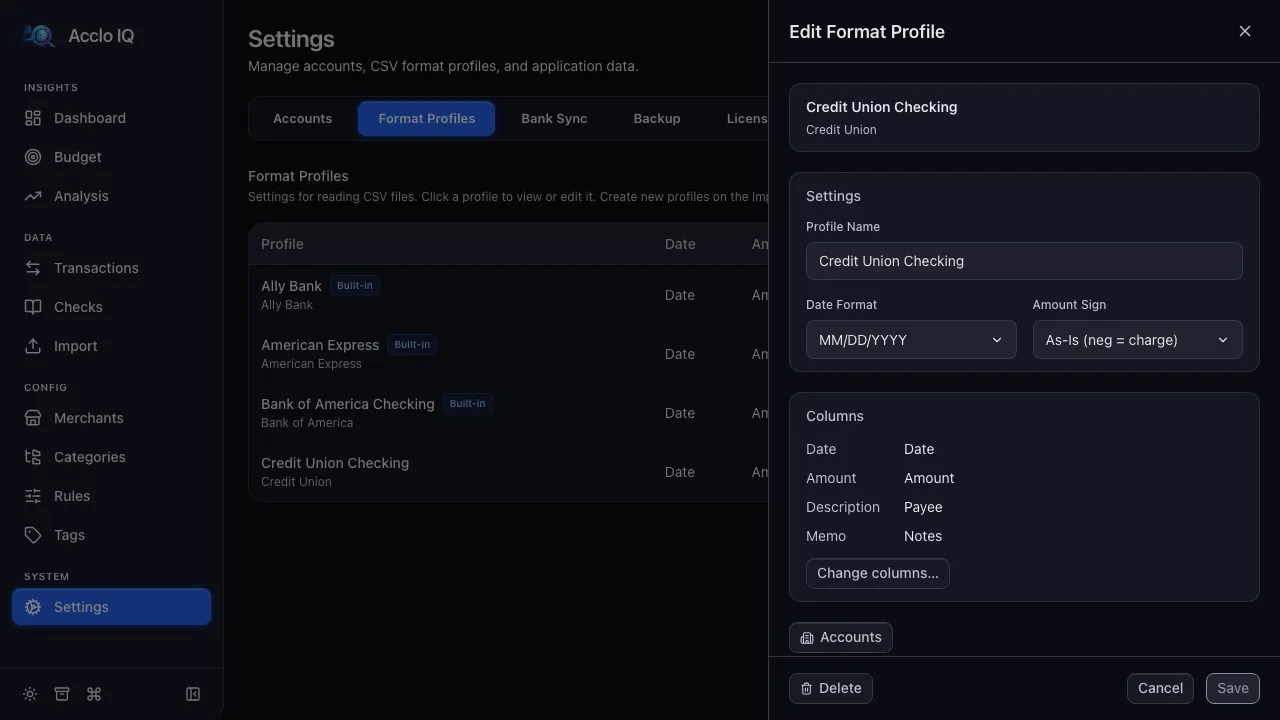
Section titled “Viewing Format Profiles”Go to Settings > Format Profiles to see the profiles your accounts use, plus any custom profiles you’ve created. Every built-in profile is still available when you import a CSV. The table shows:
| Column | Description |
|---|---|
| Profile | Name, institution, and whether it’s built-in |
| Date | The column with the transaction date |
| Amount | The column with the amount (both columns, for banks that split debits and credits) |
| Description | The column with the description |
| Memo | The column with extra notes, if the profile reads one |
| Accounts | How many accounts use this profile |
Creating a Custom Profile
Section titled “Creating a Custom Profile”Custom profiles are created during CSV import when no existing profile matches:
-
Go to the Import page and select your account
-
Click Create a new format profile
-
Upload a sample CSV file — the app suggests a role for each column and detects the date format
-
Review the column mapping and assign roles to each column:
- Date — the transaction date column (required)
- Amount — the transaction amount column (required)
- Description — the transaction description (required)
- Memo — optional additional text
- Skip — ignore this column
Each role can go to only one column. Choosing a role that another column already has moves it there.
-
Configure profile settings:
- Profile Name — a descriptive name (defaults to your account name + “CSV”)
- Date Format — MM/DD/YYYY, YYYY-MM-DD, MM/DD/YY, MM-DD-YYYY, or MM-DD-YY. If the app can’t tell the format from your file, choose one before saving.
- Amount Sign — “As-Is” (negative = charge) or “Invert” (positive = charge)
-
Click Create Profile
The profile is saved and immediately available for future imports.
Deleting a Profile
Section titled “Deleting a Profile”Custom profiles can be deleted from Settings > Format Profiles if no accounts currently use them. The delete button is disabled for profiles with linked accounts.
- Most banks use “As-Is” amount sign (negative = money out)
- If your amounts appear reversed after import, edit the profile and change the amount sign to “Invert”
Related Guides
Section titled “Related Guides”- CSV Import — use format profiles during the import process
- Supported Banks — full list of built-in bank profiles